





The 7 Best YNAB Alternatives in 2026 (Free & Paid)
I used YNAB for almost two years. The method works. The price is fair. The mobile app is good. But every Sunday I’d sit down, assign every dollar to a category, and reconcile spending I’d already done. After a while it stopped feeling like financial control and started feeling like a second part-time job.
If you’re hitting the same wall, you have options. The short answer: Bonsave if you want AI to do the work for you, Monarch Money if you want shared household budgeting, and EveryDollar if you want a free zero-based alternative. The right pick depends on which part of YNAB you want to keep and which part you want to drop, so here’s the full breakdown.
Why people leave YNAB
Three things show up over and over in the “why I quit YNAB” posts on Reddit:
- The manual work. Zero-based budgeting means you assign every dollar of income to a category before you spend it. That’s the whole point of the method, but it’s also a daily commitment most people stop honoring after a few months.
- The price. YNAB raised its price to $109/year a couple of cycles ago. For a budgeting-only app with no net worth tracking or investment view, that’s a stretch.
- The narrow scope. YNAB doesn’t track net worth in a meaningful way, has no real investment analysis, and treats money you’ve already saved as basically invisible. If you want a financial dashboard, YNAB isn’t it.
The apps below tackle one or more of those pain points without making you give up the structure entirely.
The best YNAB alternatives at a glance
| App | Best for | Price | Zero-based budgeting | Net worth tracking | AI features |
|---|---|---|---|---|---|
| Bonsave | AI doing the work for you | $84/yr | No (category targets) | Yes | Yes (daily insights + chat) |
| Monarch Money | Couples & households | $99.99/yr | Optional | Yes | Basic |
| Copilot | Polished iOS experience | $95/yr | No (categories) | Yes | Basic |
| EveryDollar | Free zero-based budgeting | Free / $79.99/yr Premium | Yes | No | No |
| Goodbudget | Envelope method, couples | Free / $80/yr Plus | Yes (envelopes) | No | No |
| Simplifi by Quicken | Spending plans without YNAB rigor | $47.99/yr | No (spending plan) | Basic | No |
| Empower Personal Dashboard | Free investment tracking | Free | No | Yes | No |
1. Bonsave: Best for AI doing the work for you
If the part of YNAB you hated was sitting down every week to assign dollars and categorize transactions, Bonsave is the cleanest exit. It’s built on the opposite premise: connect your accounts, let AI surface what you actually need to know, and skip the manual ceremony.
You still get category budgets if you want them, but the day-to-day work is gone. Bonsave supports the same institutions YNAB does (Chase, Bank of America, Fidelity, Wealthfront, and hundreds more) through Plaid, plus manual entries for crypto, real estate, and vehicles.
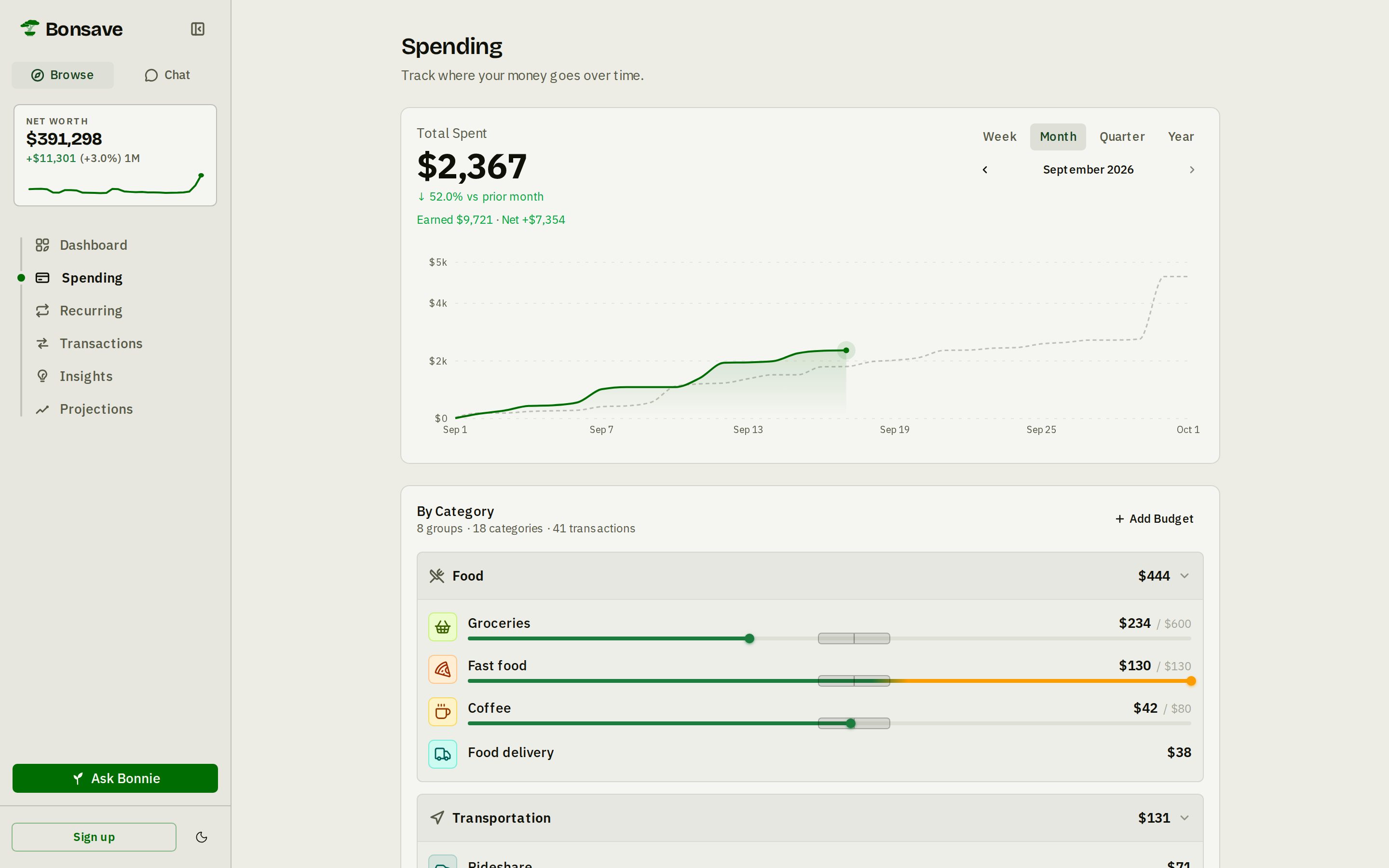
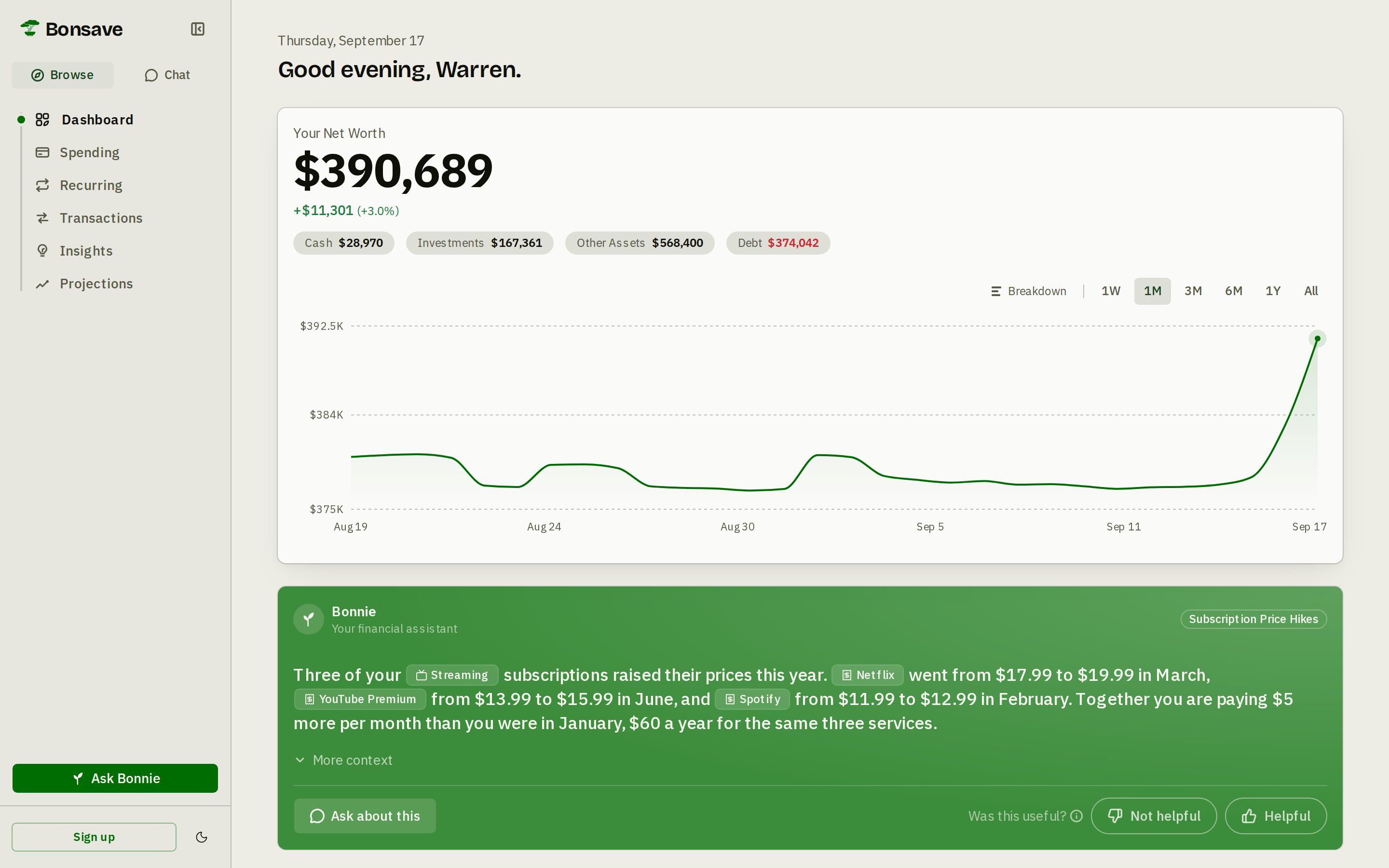
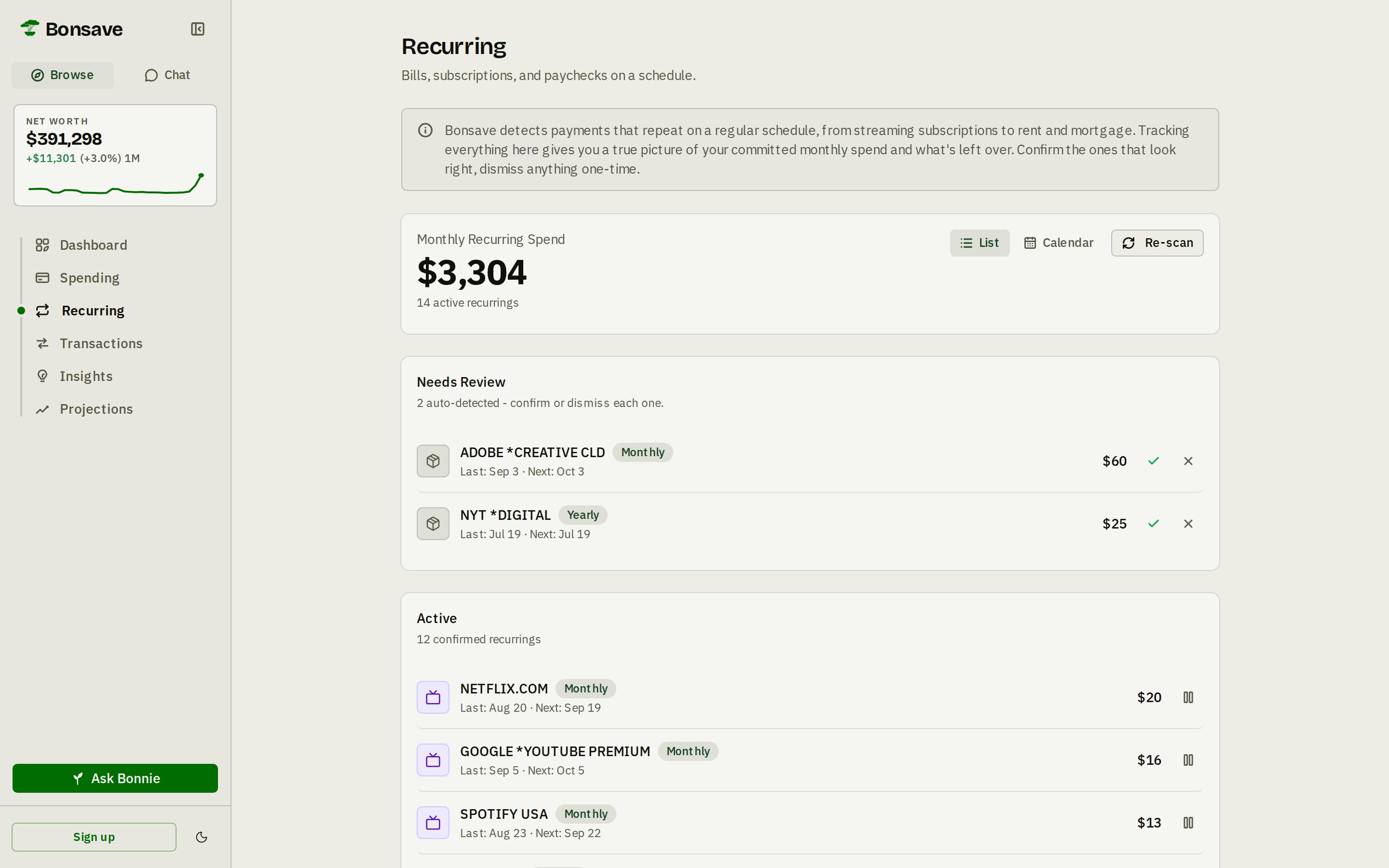
The differentiator is Bonnie, the built-in AI financial assistant.
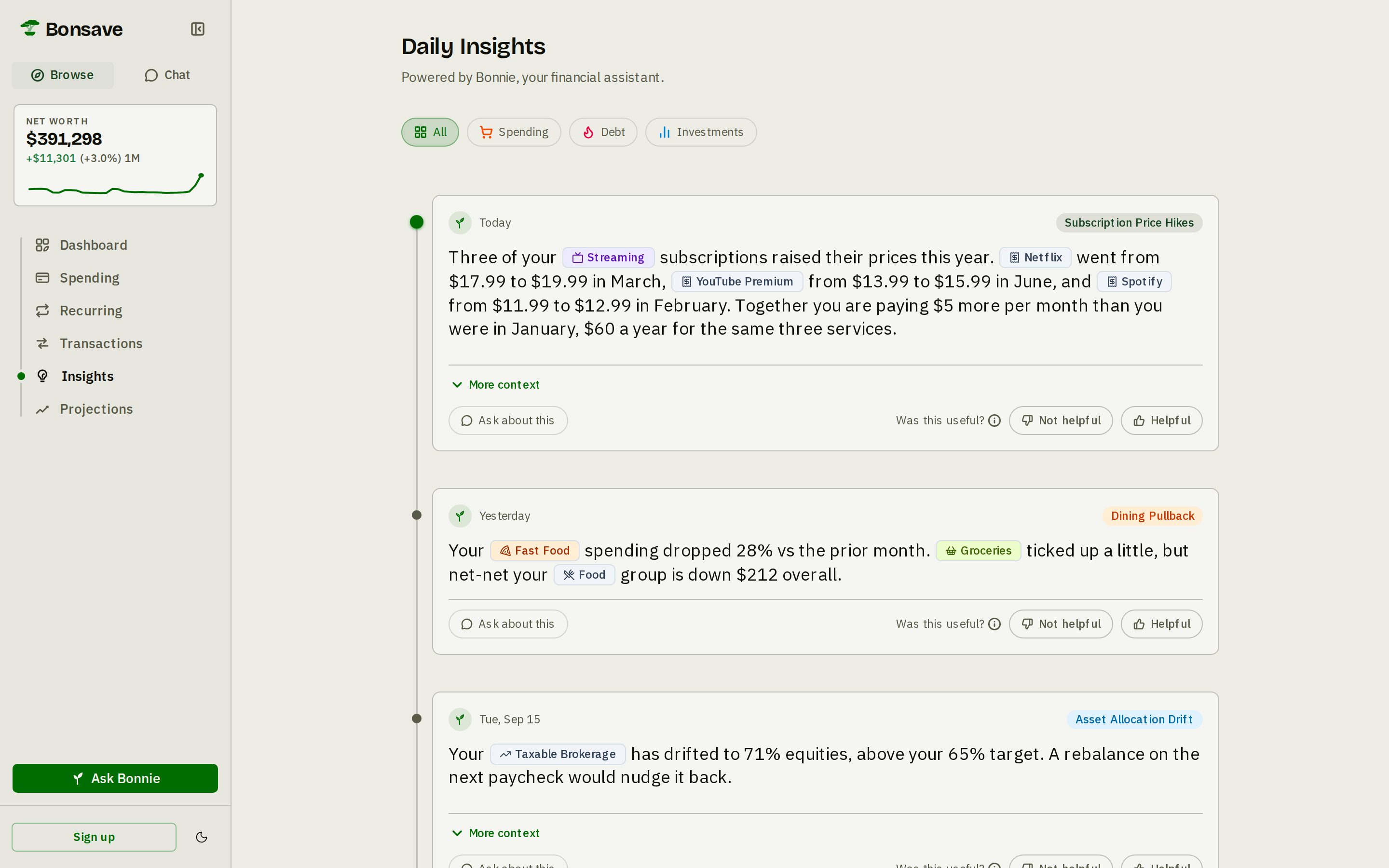
Every morning Bonnie surfaces one specific observation about your finances. Not a dashboard you have to read. One sentence: a subscription that quietly increased, a category that crept over budget, a savings rate that was unusually strong this month. It takes five seconds and you actually learn something.
You can also chat with Bonnie directly. Not generic personal finance advice, but specific questions about your accounts: “Why did my net worth drop last month?” or “What’s my worst-performing investment?” It knows your data and answers in context.
What Bonsave does well:
- Daily AI insights that surface what matters without manual review
- AI chat that knows your actual financial data
- Full net worth tracking with historical charts (YNAB doesn’t do this)
- Investment account aggregation and analysis
- Subscription and recurring payment detection
- Manual holdings (crypto, real estate, vehicles)
What Bonsave doesn’t do:
- Strict zero-based budgeting (if the method itself is what you want, EveryDollar or YNAB are better fits)
- Shared household access (Monarch wins here)
Pricing: $7/month ($84/year), 14-day free trial. Start your free trial
2. Monarch Money: Best for couples and households
Monarch is the YNAB alternative most ex-YNAB couples end up at. Multiple people can log in, see the same dashboard, and manage shared finances together, which YNAB technically supports but has never made elegant. It has solid budgeting tools (you can run something close to zero-based if you want), net worth tracking, investment views, and clean transaction management.
At $99.99/year it’s priced slightly below YNAB, and the shared-access feature alone justifies the switch for households. The AI assistant is basic compared to Bonsave (you can ask questions, but it doesn’t proactively surface insights), and the budgeting layer is less opinionated than YNAB’s, which is either freeing or anchoring depending on your taste.
Best for: Couples or households managing finances together who want budgeting plus net worth.
Pricing: $99.99/year, 7-day free trial. monarchmoney.com
3. Copilot: Best for a polished iOS-first experience
Copilot is the best-looking personal finance app on the market. If you used YNAB on iPhone and your main complaint was that it felt clunky, Copilot is a meaningful upgrade in design. Transaction categorization is smart and learns from your corrections, the spending visualizations are clean, and it tracks net worth across accounts.
The catches: it’s iOS-only, so if a partner is on Android this is a non-starter. It’s $95/year, close to YNAB pricing. And it leans toward passive tracking, not active budgeting, so if the YNAB method was the value for you this is a step away from it.
Best for: iPhone users who want the nicest-looking app and don’t need strict zero-based budgeting.
Pricing: $95/year, 30-day free trial. copilot.money
4. EveryDollar: Best free zero-based alternative
EveryDollar is Dave Ramsey’s budgeting app, and it follows the same zero-based philosophy as YNAB: every dollar gets a job before you spend it. The free tier is real (manual entry only), and Premium ($79.99/year) adds bank connections and a few advanced features.
If you genuinely love the zero-based method and want a YNAB clone for less money, EveryDollar is the closest thing. The interface is less refined than YNAB’s, the bank connections can be flaky, and there’s no real net worth view. You’re also opting into Ramsey’s broader financial worldview, which some people love and some don’t. But for $30/year less than YNAB with the same fundamental approach, it’s a fair trade.
Best for: People who want zero-based budgeting at a lower price (or free, if you don’t mind manual entry).
Pricing: Free tier available; Premium $79.99/year. ramseysolutions.com/everydollar
5. Goodbudget: Best for the original envelope method
Goodbudget is the digital evolution of the cash envelope system, which is the spiritual ancestor of YNAB’s zero-based method. You create envelopes (categories), fund them at the start of the month, and spend only from each envelope. It’s been around since 2009.
The free tier is generous (20 envelopes, two devices), and Plus at $80/year unlocks unlimited envelopes and bank syncing. It’s not as polished as YNAB or Monarch, but the philosophy is dead simple and the app does exactly what it says. Particularly good for couples who want both phones synced to the same envelopes.
Best for: People who like the envelope method specifically, or couples wanting shared envelopes.
Pricing: Free tier available; Plus $80/year. goodbudget.com
6. Simplifi by Quicken: Best for spending plans without YNAB rigor
Simplifi is Quicken’s modern app (separate from the legacy Quicken desktop product). Instead of zero-based budgeting it uses a “spending plan”: you tell it your income, fixed bills, and savings goals, and it shows you what’s left to spend. It’s looser than YNAB but still gives you structure.
At $3.99/month ($47.99/year) it’s the cheapest paid app on this list, and it handles the basics well: account aggregation, transaction categorization, simple net worth tracking, recurring transaction detection. The interface won’t wow you, but it’s reliable.
Best for: People who want some structure but don’t want to assign every dollar.
Pricing: $47.99/year. simplifimoney.com
7. Empower Personal Dashboard: Best free option for investors
Empower (formerly Personal Capital) isn’t really a budgeting app. It’s a net worth and investment tracker with a thin budgeting layer on top. But if YNAB’s biggest gap for you was that it couldn’t see your investment portfolio, Empower fills that gap entirely. And the tracking side is free.
Expect outreach from their wealth management advisors if your investable assets cross a threshold (that’s how Empower makes money). If you can ignore that, the free investment dashboard is excellent. Pair it with a dedicated budgeting app and you’ve replaced YNAB’s tracking gap for $0.
Best for: Investors who want free portfolio and net worth tracking and don’t need detailed budgeting.
If you’re deciding between Empower and Monarch, see Monarch vs Empower for a head-to-head breakdown.
Pricing: Free (tracking). Wealth management starts at 0.89% AUM. empower.com
Free YNAB alternatives worth using
If price is the main reason you’re leaving YNAB, three of the apps above have legitimate free tiers. They handle different parts of what YNAB does:
- EveryDollar (free tier) is the closest free YNAB alternative for zero-based budgeting itself. Manual entry only on the free plan, but the underlying method is intact. If you loved YNAB’s philosophy and just want it for less money, this is the pick.
- Goodbudget (free tier) gives you 20 envelopes synced across two devices at no cost. The envelope method is the spiritual ancestor of YNAB’s zero-based approach, so the muscle memory carries over. Couples can share envelopes on the free tier, which YNAB charges full price for.
- Empower Personal Dashboard is free for net worth and investment tracking. It’s not a budgeting app the way YNAB is, but if your YNAB use was mostly “see all my accounts in one place,” Empower covers that gap without the $109/year.
The honest tradeoff with free YNAB alternatives: you’re either giving up bank connections (EveryDollar’s free tier, Goodbudget’s free tier) or giving up budgeting structure (Empower). Paid tiers on EveryDollar and Goodbudget restore bank connections for $79.99 and $80 a year respectively, still cheaper than YNAB.
If you used Mint and ended up at YNAB, you might also want to see our breakdown of Mint alternatives, which covers the passive-tracking side of the spectrum.
How to choose
You loved YNAB’s method but hated the price → EveryDollar (paid) or Goodbudget (free tier with envelopes).
You’re sick of the manual work → Bonsave. AI surfaces what matters without weekly reconciliation.
You’re managing money with a partner → Monarch Money for shared budgeting, or Goodbudget for shared envelopes.
You want the nicest-looking app → Copilot (iOS only).
You want a middle ground between zero-based and passive tracking → Simplifi.
You mostly care about investments and net worth → Empower for the free tier, or Bonsave if you also want AI-powered spending insights.
One thing YNAB never told you is how your overall picture compares. If you’re curious, our average net worth by age guide has the Federal Reserve percentile breakdowns, and the net worth percentile calculator gives you your exact rank.
Frequently asked questions
Is YNAB worth the $109/year?
If you actively use the zero-based method and it's changed your financial life, yes. If you've been paying for it but the manual reconciliation has fallen off, the answer is almost always no. Most of these alternatives do the tracking part as well or better.
Is there a free YNAB alternative?
EveryDollar has a free tier (manual entry), Goodbudget has a free tier (20 envelopes, two devices), and Empower is free for net worth and investment tracking. For the closest free zero-based experience, start with EveryDollar.
What's the best YNAB alternative for couples?
Monarch Money. Both partners log in to the same dashboard with full visibility and shared categories. Goodbudget is a strong free-tier runner-up if you specifically want envelopes.
Does any YNAB alternative have AI?
Bonsave is the only personal finance app on this list with a built-in AI assistant that knows your actual financial data. It surfaces a daily insight automatically and you can chat with it about your specific accounts.
Can I move my YNAB data to another app?
YNAB lets you export your transaction history as CSV. Most alternatives don't import YNAB's category structure directly, but transactions and balances are easy to bring over. Plan on rebuilding your category setup from scratch, which is honestly a good chance to simplify it.
What's the difference between a YNAB alternative and a Mint alternative?
Mint was passive tracking (connect accounts, see where money went). YNAB is active budgeting (assign every dollar before you spend it). The apps that replace each fall into different camps. If you're not sure which you want, our breakdown of Mint alternatives covers the passive-tracking side.