





The 6 Best Net Worth Tracker Apps in 2026 (Free & Paid)
I started tracking my net worth in a Google Sheet when I was 22. Every month I’d log in to seven different accounts, write down the balances, and watch the number tick up (or, more often, tick sideways). It was a 30-minute chore that I’d do roughly twice a year because nobody actually sticks to a monthly manual update.
Net worth tracker apps exist so you don’t have to do that. They connect to your accounts, pull the balances automatically, and show you a chart that updates itself. The question isn’t whether to use one. It’s which one. Here’s the honest landscape in 2026.
What “net worth tracking” actually means
Before the list, a definition. A real net worth tracker needs to do four things:
- Aggregate every account in one place. Bank, credit cards, brokerage, retirement, crypto. Anything you own or owe.
- Update automatically. Manual entry is fine for a one-time snapshot but useless for tracking trends.
- Track manual assets too. Cars, real estate, private equity, collectibles. These are often a huge chunk of net worth, and you can’t connect them to anything.
- Show history. A single number is almost meaningless. You need to see the trajectory.
A lot of apps call themselves net worth trackers but only do one or two of these. The ones below do all four (or have a clear, useful tradeoff).
The best net worth tracker apps at a glance
| App | Best for | Price | Manual assets | History | Investment analysis |
|---|---|---|---|---|---|
| Bonsave | AI insights on top of tracking | $84/yr | Yes | Yes | Yes |
| Empower Personal Dashboard | Free investment-heavy users | Free | Limited | Yes | Yes |
| Kubera | High net worth, complex assets | $150/yr | Yes (extensive) | Yes | Limited |
| Monarch Money | Couples and households | $99.99/yr | Yes | Yes | Basic |
| Copilot | Polished iOS users | $95/yr | Yes | Yes | Basic |
| Tiller Money | Spreadsheet users | $79/yr | Manual | Manual | Manual |
1. Bonsave: Best for AI-powered tracking
Full disclosure: I built this one. But I built it because nothing else combined automatic net worth aggregation with the AI layer I actually wanted.
Bonsave connects to your bank, brokerage, retirement, and credit card accounts through Plaid, plus lets you add manual assets like crypto, real estate, and vehicles. You get a clean net worth chart with historical data, broken down by asset class. Standard stuff.
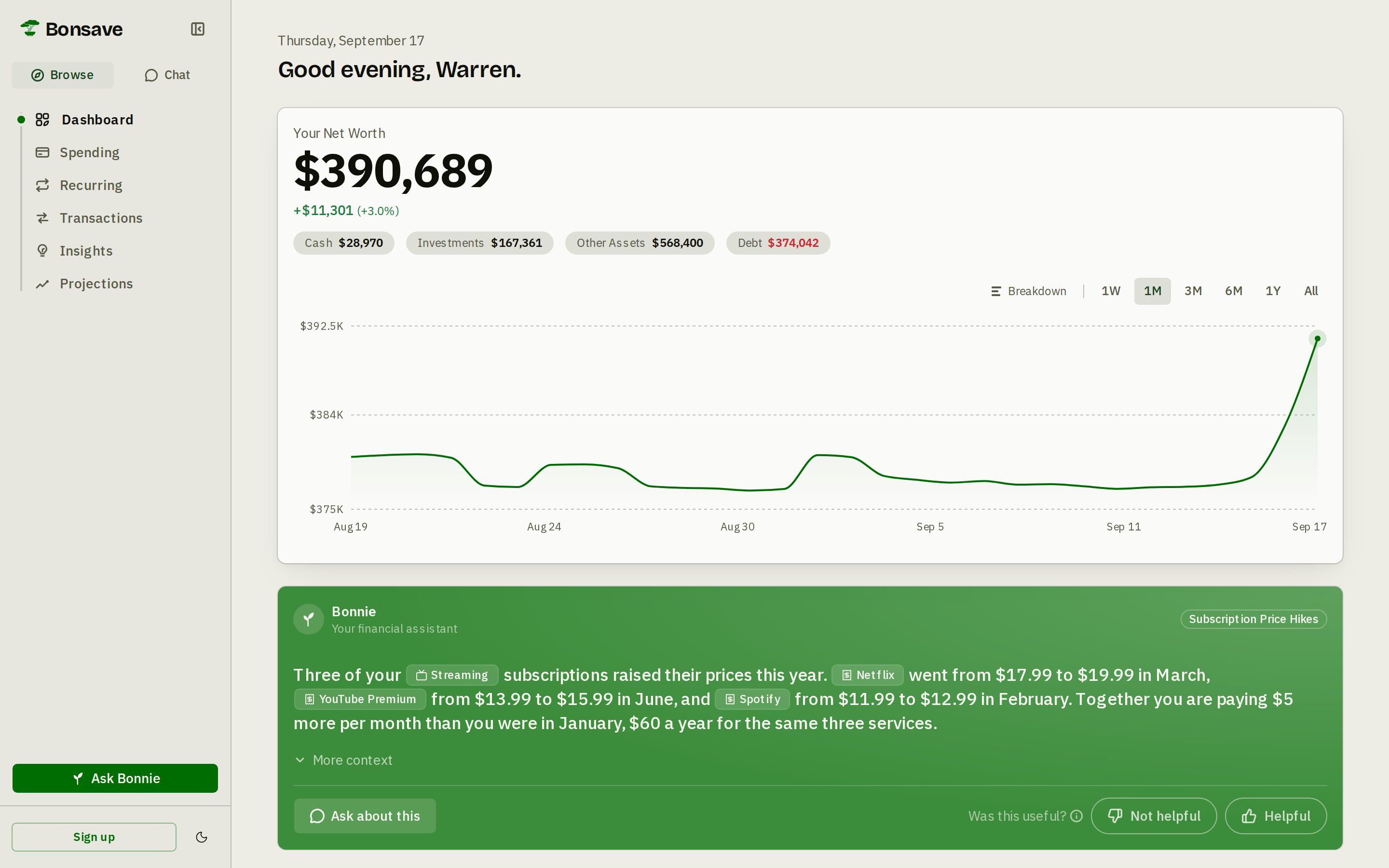
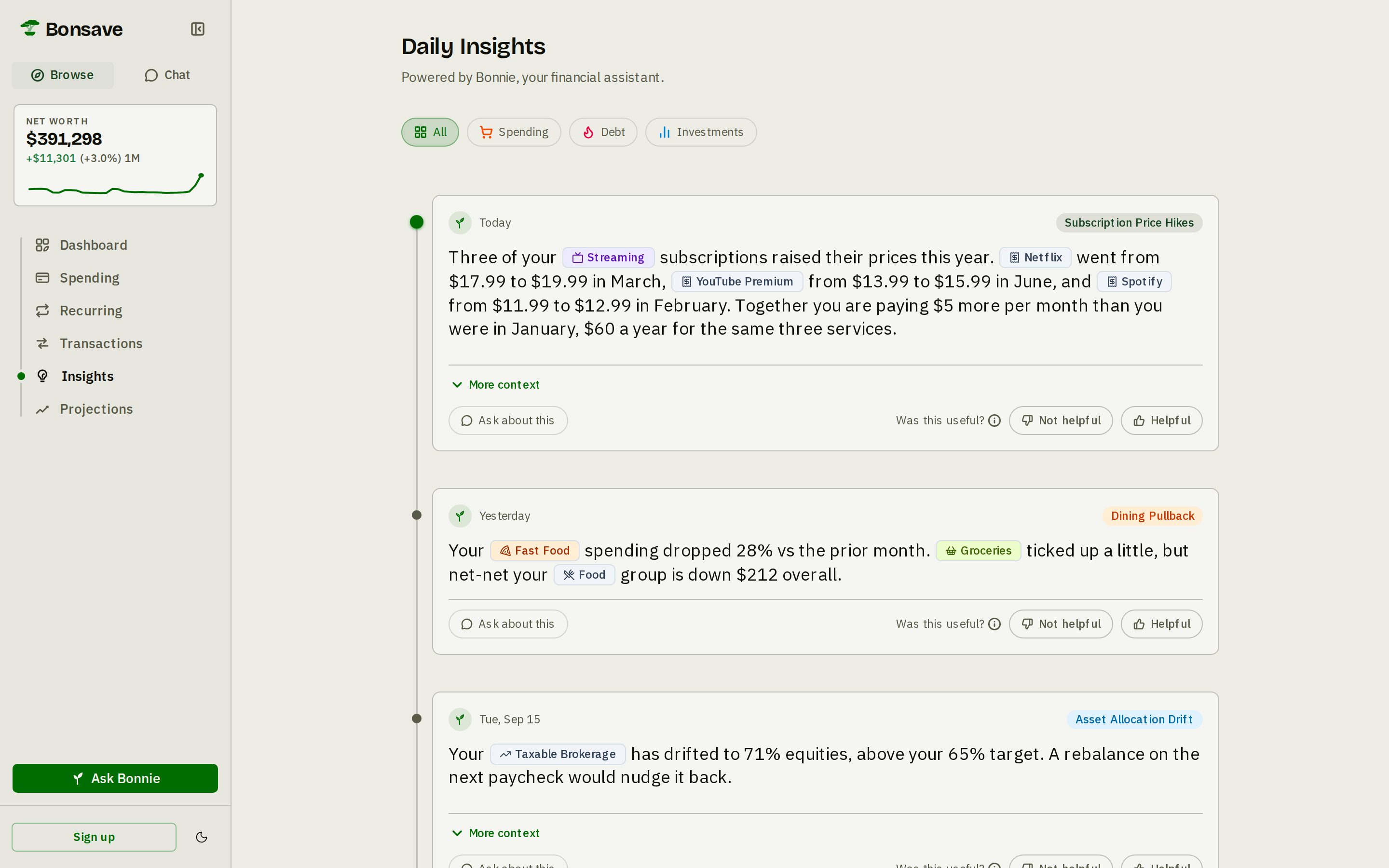
The differentiator is the AI layer on top. Every morning, Bonsave surfaces one specific observation: a category that went over budget, a savings rate that was unusually strong, an account balance shift worth noting. You can also chat directly: “Why did my net worth drop last month?” and get a real, contextualized answer pointing to the actual cause (market dip, a big credit card balance, a paycheck that hadn’t landed yet).
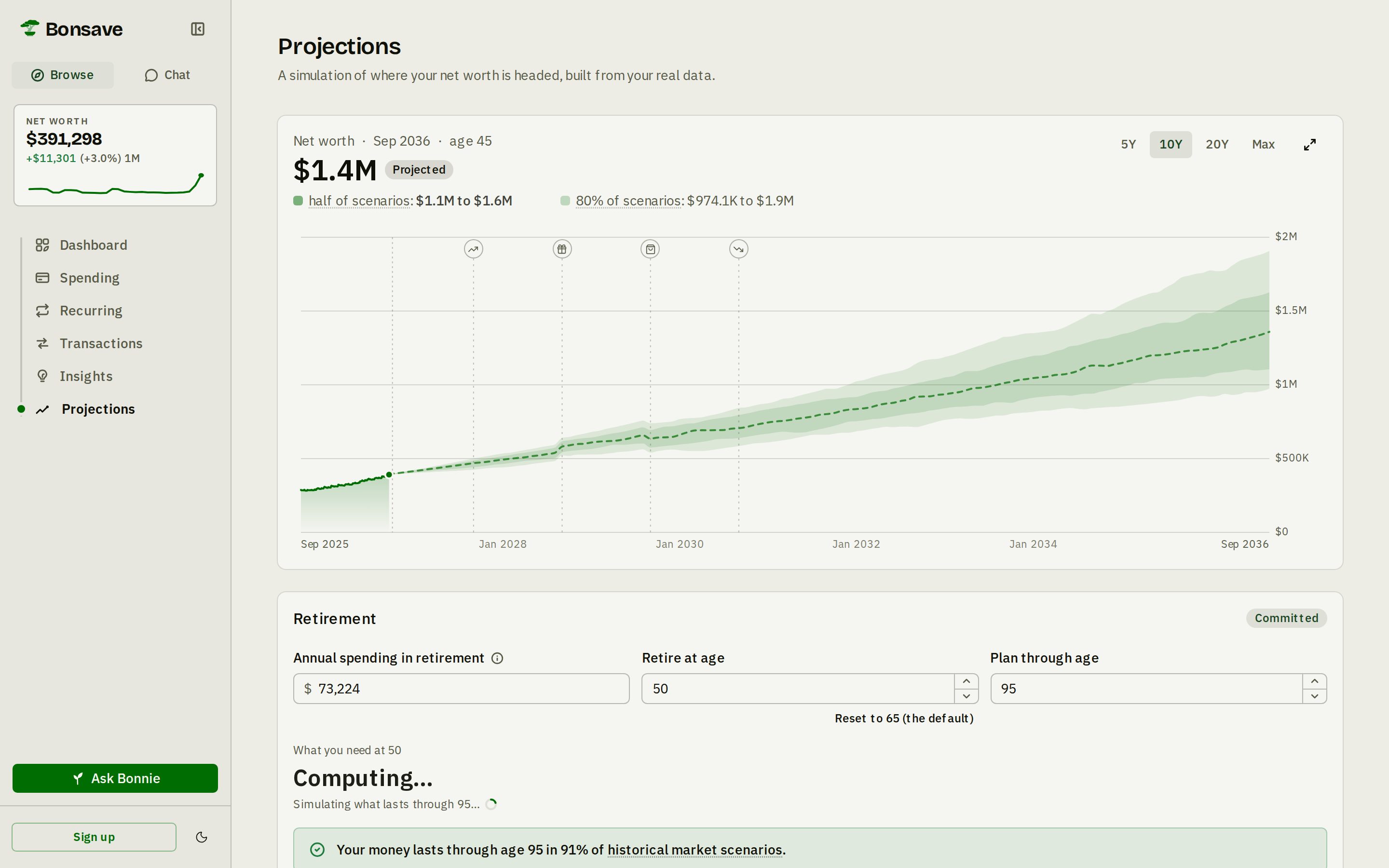
For tracking specifically, Bonsave also handles the parts most apps skip: liability tracking, FIRE projections, and recurring subscription detection that affects your savings rate over time.
Best for: People who want automatic tracking plus AI that explains what’s happening to their money.
Pricing: $7/month ($84/year), 14-day free trial. Start your free trial
2. Empower Personal Dashboard: Best free net worth tracker
Empower (formerly Personal Capital) is the dominant free net worth tracker, and it deserves the reputation. Connect your accounts, get a real-time net worth view, see asset allocation, and use their retirement planner. The investment analysis is the strongest part: fee analyzer, portfolio breakdown, hidden mutual fund cost detection.
The catch is the business model. Empower’s investment tracking is free because they sell wealth management services on top of it. If your investable assets cross a threshold (roughly $100K), expect calls and emails from their advisors. If you’re comfortable saying “no thanks” repeatedly, the free product is excellent. If that pressure annoys you, look elsewhere.
It’s also weaker on the budgeting side and on manual non-investment assets (real estate, crypto, private equity). If you came here from Mint specifically, our Mint alternatives breakdown covers Empower in the broader context of replacements.
Best for: Investors who want strong portfolio analysis for free and can tolerate sales outreach.
Pricing: Free for tracking. Wealth management starts at 0.89% AUM. empower.com
3. Kubera: Best for high net worth and complex assets
Kubera is the tracker built specifically for people whose net worth is complicated. Multiple homes, private equity, startup equity, crypto across cold wallets, collectibles, foreign currency accounts. Kubera handles all of it, with proper depreciation schedules for vehicles, real estate Zillow integration, and dead-man’s switch features for estate planning.
At $150/year it’s the most expensive option on this list, and that price makes sense once you have enough complexity to need it. If your net worth is mostly in one brokerage and one bank account, Kubera is overkill. If you’re tracking 30+ accounts across multiple asset classes, it’s the right tool.
The downside: it’s purely a tracker. No budgeting, no AI insights, no real planning tools beyond projections.
Best for: High net worth individuals with complex, multi-asset portfolios.
Pricing: $150/year, 14-day free trial. kubera.com
4. Monarch Money: Best for couples
Monarch handles net worth tracking well and adds the one feature most other apps still get wrong: shared household access. Both partners log in to the same dashboard, with full visibility into shared and individual accounts. It has solid budgeting tools alongside the tracking, and the historical net worth view is clean.
At $99.99/year it’s competitively priced for what you get. The AI layer is basic compared to Bonsave (you can ask questions, but it doesn’t proactively surface insights), and the investment analysis is lighter than Empower’s. But for households managing finances together, the shared-access feature alone is worth the price.
Best for: Couples or households who want net worth tracking plus shared budgeting.
Pricing: $99.99/year, 7-day free trial. monarchmoney.com
5. Copilot: Best for polished iOS users
Copilot is the prettiest app on this list. Net worth tracking is solid, with clean visualizations, smart transaction categorization, and a strong investment view. Manual assets work fine for cars and real estate. The iOS app is one of the best designed financial apps period.
The two limitations: it’s iOS only (no Android, no web), and it’s primarily a passive tracker. There’s no real AI insight layer or active financial guidance. If you live on iPhone and you care about design more than features, this is the pick.
Best for: iPhone users who care most about interface quality.
Pricing: $95/year, 30-day free trial. copilot.money
6. Tiller Money: Best for spreadsheet users
Tiller pulls your transaction and balance data into Google Sheets or Excel automatically every day. You build your own net worth dashboard with formulas, and Tiller keeps the underlying data fresh. There are pre-built templates if you don’t want to start from scratch.
This is the only option on the list with no app or web UI. You’re committing to spreadsheets as your interface, which is great if you already think in spreadsheets and terrible if you don’t.
Best for: People who already run their finances in Google Sheets and want auto-import.
Pricing: $79/year, 30-day free trial. tillerhq.com
Free net worth trackers worth using
If you don’t want to pay anything, the free options on this list narrow to one realistic choice:
- Empower Personal Dashboard is the only fully free net worth tracker here. It covers the core job (aggregation, history, investment analysis) and the free tier is sustainable long term. Just expect sales outreach if your investable assets are significant.
Two honorable mentions for free alternatives outside this list: Sharesight has a free tier for investment tracking specifically (10 holdings), and NetWorthShare offers a spreadsheet-based tracker for free if you’re willing to do manual updates. For most people, Empower is the right starting point and you can graduate to a paid app once you outgrow it.
How to choose
If you’re investment-heavy and don’t want to pay, Empower is the obvious starting point. The free tier alone covers what most people need from a net worth tracker.
If you want tracking plus an AI layer that actually tells you what’s happening to your money, Bonsave is the only app on this list that does it.
If your finances are genuinely complex (multiple properties, private equity, alternative assets), Kubera is built for you and worth the $150.
If you’re managing money with a partner, Monarch is the right answer.
If you’re stuck between those two specifically, our Monarch vs Empower comparison covers pricing, retirement planning, and what Empower’s free dashboard costs if you say yes to its advisors.
If you live on iPhone and prioritize design, Copilot.
If you already have a spreadsheet workflow, Tiller.
If you also want active budgeting on top of net worth tracking, see our YNAB alternatives breakdown for apps that pair budgeting structure with net worth views.
And once you’re tracking, context makes the number mean something. Our average net worth by age guide breaks down Federal Reserve percentile data by bracket, and the net worth percentile calculator gives you your exact rank against households your age.
The one thing I’d skip: any app that requires you to manually update balances. In 2026, with Plaid covering nearly every US institution, manual aggregation is a chore that has a better solution. Pick one of the apps above and let the connections do the work.
I’m obviously biased about which one. If you want to try Bonsave, the 14-day free trial is the easiest way to see whether the AI layer changes anything for you.
Frequently asked questions
What's the best free net worth tracker?
Empower Personal Dashboard is the best free net worth tracker in 2026. Connect your accounts, get a real-time net worth view, and use their portfolio analysis tools. The tradeoff is that Empower's business model is wealth management, so expect outreach from their advisors if your investable assets cross roughly $100K.
Did Personal Capital change its name?
Yes. Personal Capital was acquired by Empower Retirement and rebranded as Empower Personal Dashboard. The product is the same and the free net worth tracking remains free.
Does Mint still work as a net worth tracker?
No. Intuit shut down Mint in January 2024 and migrated users to Credit Karma, which dropped net worth tracking entirely. If you used Mint for net worth, see our breakdown of Mint alternatives for direct replacements.
What's the best net worth tracker for couples?
Monarch Money. Both partners log in to the same dashboard with full visibility into shared and individual accounts, and the net worth chart aggregates everything correctly across the household.
Are net worth tracker apps safe?
The apps on this list connect to financial institutions through Plaid or similar aggregators, which use read-only access and don't store your bank credentials directly. None of them can move money. The risk profile is similar to using your bank's mobile app.
How is a net worth tracker different from a budgeting app?
A net worth tracker focuses on what you own minus what you owe, with history and asset breakdowns. A budgeting app focuses on what you spend each month against category targets. Some apps (Bonsave, Monarch) do both well. Pure budgeting apps like YNAB don't really track net worth. See our YNAB alternatives breakdown if you want a budgeting tool that also tracks net worth.