





The 7 Best Mint Alternatives in 2026 (Free & Paid)
I built Bonsave because I was tired of the alternatives. I started years ago as a Mint user, then when they went away I switched to Rocket Money but I still couldn’t find a replacement that did what I actually wanted: connect all my accounts, tell me something useful, and get out of the way. Most apps either overwhelm you with dashboards or require too much manual work to be worth it.
Mint shut down in January 2024. If you’re still looking for a replacement, the short answer is: Bonsave for AI-powered insights, YNAB if you want zero-based budgeting structure, and Copilot if you want the most polished UI and you only want it on your iPhone. The right pick depends entirely on what you actually used Mint for, so here’s the full breakdown.
Why Mint shutting down still matters
Mint had over 3 million active users when Intuit pulled the plug. Most were migrated to Credit Karma, which does credit monitoring well but dropped budgeting, net worth tracking, and transaction categorization entirely. It was a bad trade for most Mint users.
Two years later, people are still searching for a real replacement. In 2026, the options are better than ever, but they’ve also diverged significantly in price, philosophy, and who they’re actually built for. The apps below are the ones worth considering.
The best Mint alternatives at a glance
| App | Best for | Price | Net worth tracking | AI features | Mobile app |
|---|---|---|---|---|---|
| Bonsave | Passive tracking + AI insights | $84/yr | Yes | Yes (daily insights + chat) | Yes |
| YNAB | Zero-based budgeting | $109/yr | No | No | Yes |
| Copilot | Polished UI, iOS-first | $95/yr | Yes | Basic | iOS only |
| Monarch Money | Couples & households | $99.99/yr | Yes | Basic | Yes |
| Empower Personal Dashboard | Investment tracking | Free | Yes | No | Yes |
| Simplifi by Quicken | Spending plans | $71.88/yr | Basic | No | Yes |
| Tiller Money | Spreadsheet lovers | $79/yr | Via sheets | No | No |
1. Bonsave: Best for AI-powered insights
If Mint’s main value for you was knowing where your money went without having to manually dig for it, Bonsave is the closest thing. And then some.
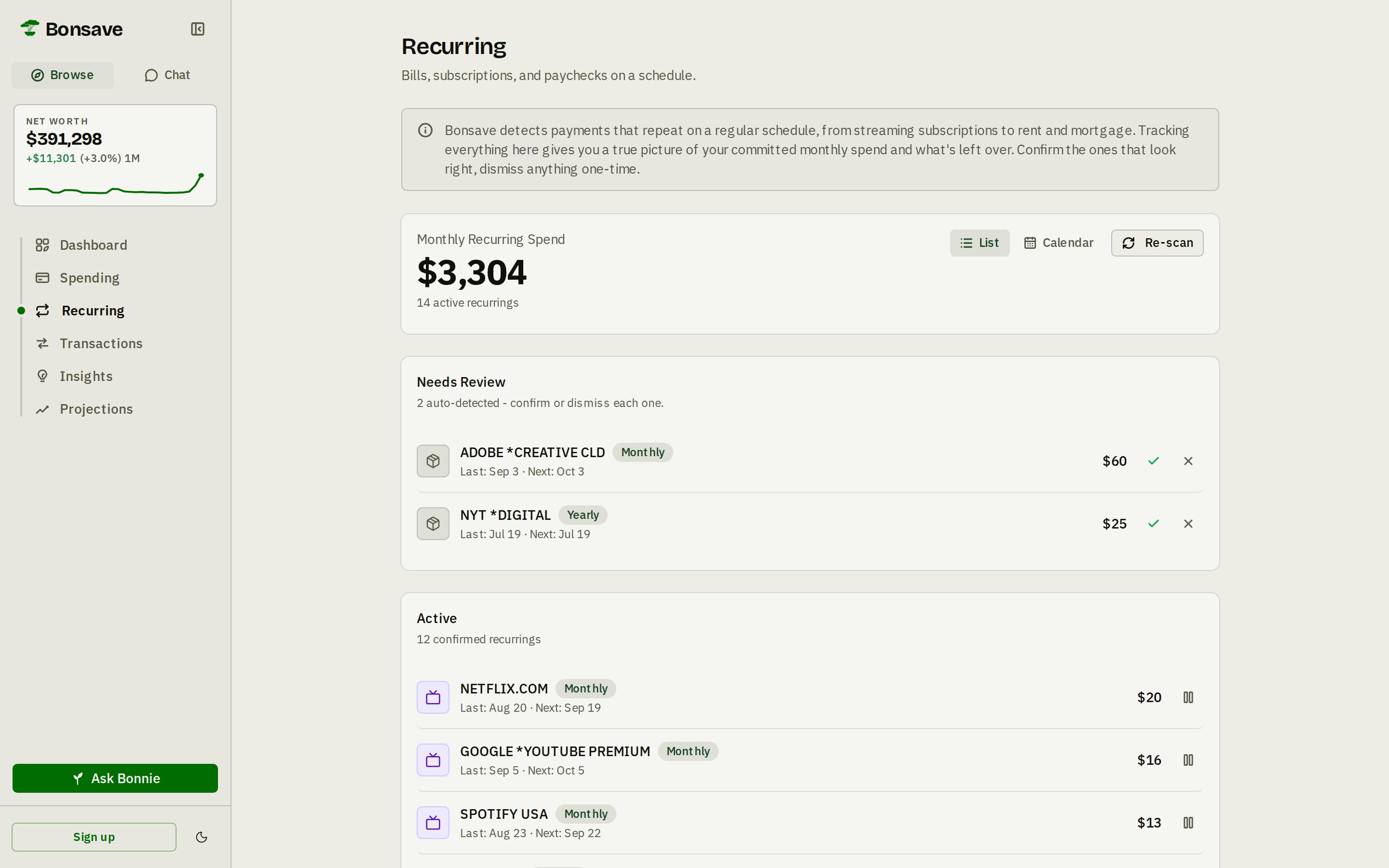
The core is familiar: connect your bank accounts, credit cards, and investment accounts, and you get a full picture of your net worth over time, spending by category, budget targets, and transaction history. Bonsave supports the same institutions Mint did (Chase, Bank of America, Fidelity, Wealthfront, and hundreds more) through Plaid.
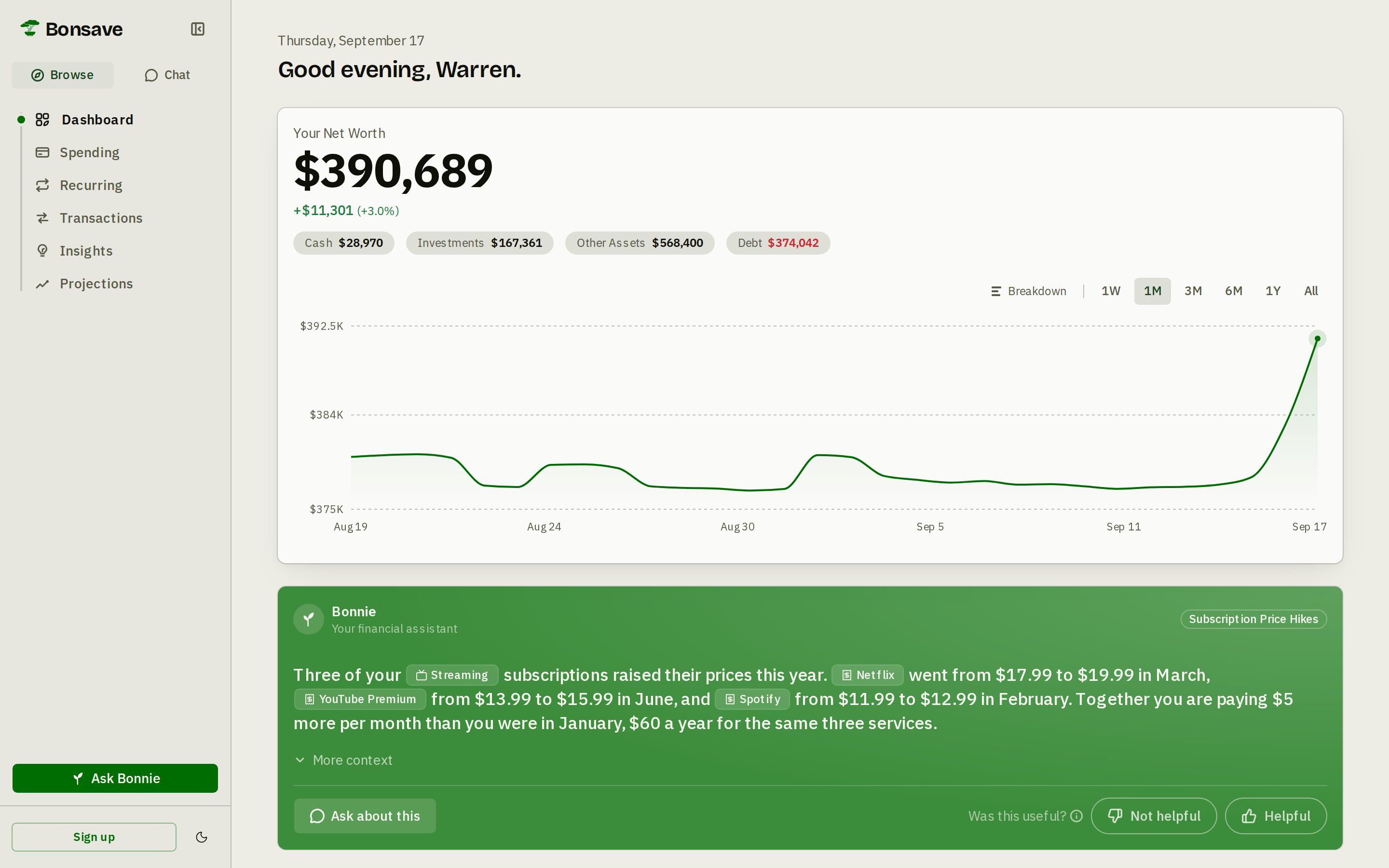
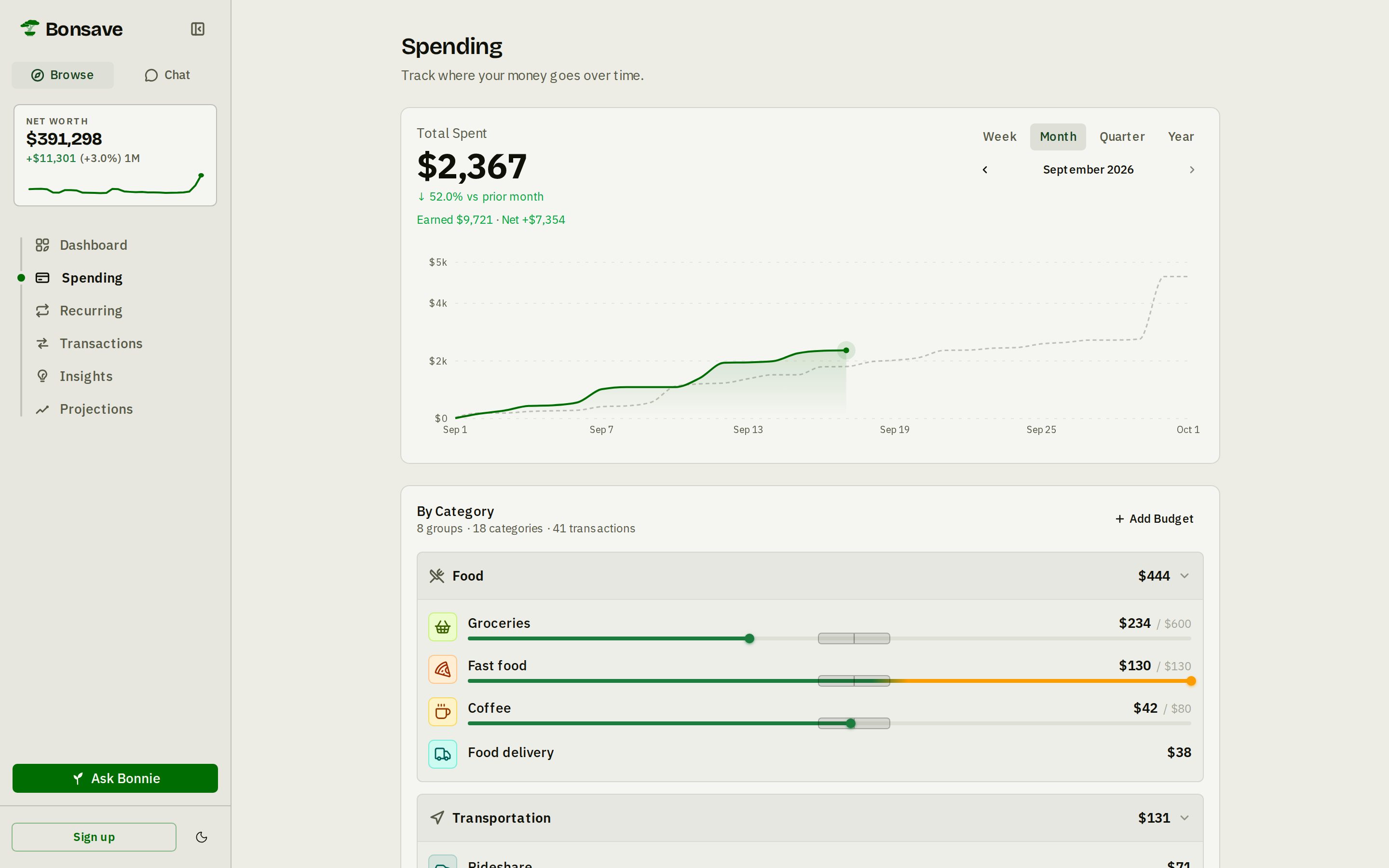
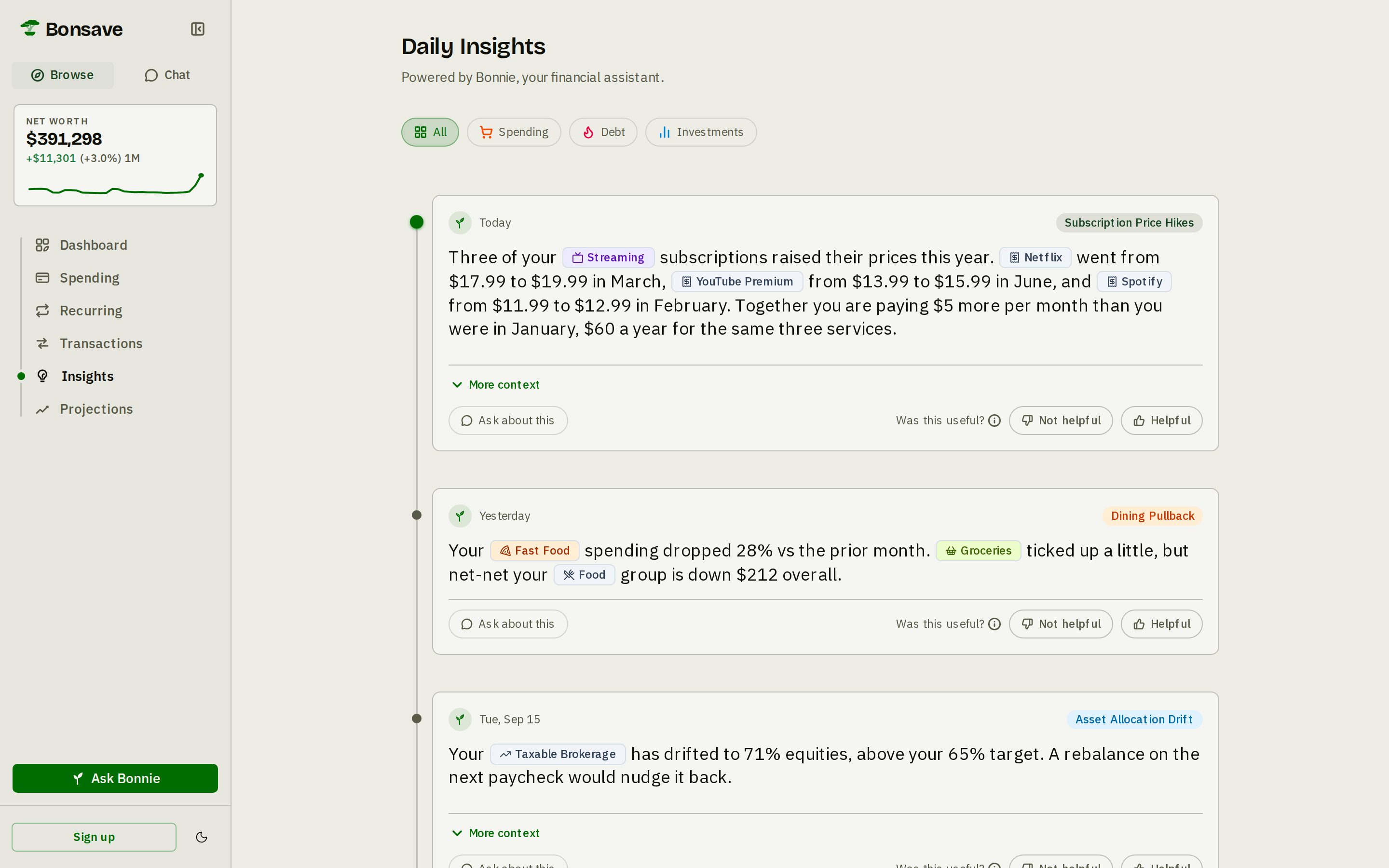
What sets it apart is Bonnie, the built-in AI financial assistant.
Every morning, Bonsave surfaces one specific insight about your finances. Not a dashboard you have to interpret. One observation: a subscription that quietly increased, a spending category that crept over budget, a month where your savings rate was unusually strong. It takes five seconds to read and you actually learn something from it.
You can also chat with Bonnie directly. Not generic personal finance advice, but questions about your accounts: “Why did my net worth drop last month?” or “What’s my worst-performing investment?” It knows your data and gives specific, contextualized answers.
What Bonsave does well:
- Daily AI insights that surface what matters without you having to look
- AI chat that knows your actual financial data
- Net worth tracking with historical charts
- Clean, fast interface with nothing buried behind tabs
- Manual holdings support (crypto, real estate, vehicles)
- Recurring payment and subscription detection
What Bonsave doesn’t do (yet):
- Zero-based budgeting (if that’s your system, YNAB is better)
- Bill pay or account management (read-only, like Mint was)
- Couples/household shared access
Pricing: $7/month ($84/year), 14-day free trial. Start your free trial
2. YNAB: Best for zero-based budgeting
YNAB (You Need A Budget) is the app most serious budgeters end up at eventually. It’s built around one philosophy: every dollar you have gets assigned a job. Income comes in, you immediately allocate it to categories (rent, groceries, savings, whatever), and you only spend from what you’ve budgeted.
This is genuinely useful if you’re trying to break the paycheck-to-paycheck cycle or build savings discipline. The method works. The app backs it up with real-time syncing, a strong mobile experience, and genuinely good customer education (their free workshops and docs are better than most paid courses).
The downsides: it’s $109/year, there’s a real learning curve, and it won’t tell you much about your investment portfolio or net worth. If Mint was primarily a passive tracker for you (you connected accounts, glanced at the graphs, moved on), YNAB will feel like homework.
Best for: People who want to actively manage every dollar and are willing to spend time doing it.
If you like the YNAB philosophy but not the price or the weekly upkeep, see our breakdown of YNAB alternatives for apps that capture some of the same structure with less work.
Pricing: $109/year, 34-day free trial. ynab.com
3. Copilot: Best for a polished, iOS-first experience
Copilot is the best-looking personal finance app on the market. If you care about design and you’re on iOS, it’s hard to beat. Transaction categorization is smart (and learns from your corrections), the spending visualizations are clear, and it tracks net worth across accounts.
The catch: it’s iOS-only, so if you or a partner uses Android, this doesn’t work. It’s also $95/year, close to YNAB pricing for less structural guidance. And like YNAB, there’s no meaningful AI layer. It’s still primarily a manual review tool.
Best for: iPhone users who want the nicest-looking budgeting app and are willing to pay for it.
Pricing: $95/year, 30-day free trial. copilot.money
4. Monarch Money: Best for couples and households
Monarch was built with couples in mind. Multiple people can log in, see the same dashboard, and manage shared finances together. Mint handled this awkwardly, and most apps still don’t do it well. It has solid budgeting tools, net worth tracking, investment views, and decent transaction management.
At $99.99/year it’s priced similarly to competitors, and the couples feature alone justifies the cost if you’re managing a household budget together. The downside is the AI assistant is basic (you can ask it questions about your budget, but it doesn’t proactively surface insights), and the interface, while functional, isn’t as polished as Copilot.
Best for: Couples or households managing finances together.
Pricing: $99.99/year, 7-day free trial. monarchmoney.com
5. Empower Personal Dashboard: Best free option for investors
Empower (formerly Personal Capital) is genuinely free for the tracking and net worth features, and it’s particularly strong on the investment side. If a significant portion of your net worth is in a 401(k), IRA, or brokerage accounts, Empower gives you portfolio analysis, fee tracking, and retirement planning tools that Mint never offered.
The free tier is legitimately good. The catch is that Empower’s business model is selling wealth management services. Expect outreach from their financial advisors if your investable assets cross a threshold. If you can ignore that, the free tools are excellent for investors.
Best for: Investors who want free portfolio and net worth tracking without budgeting features.
Pricing: Free (investment tracking). Wealth management starts at 0.89% AUM. empower.com
6. Simplifi by Quicken: Best for spending plan fans
Simplifi is Quicken’s modern app (separate from the legacy Quicken desktop software). It’s centered around a “spending plan”: you tell it your monthly income, your fixed bills, and your savings goals, and it shows you what’s left to spend. Not quite zero-based budgeting, not quite passive tracking. Somewhere in between.
At $5.99/month ($71.88/year) it’s a solid mid-range option, and it does what it says reliably. The interface is clean if not beautiful, and the account connectivity is solid. It won’t wow you, but it won’t let you down either.
Best for: People who want a structured spending plan without YNAB’s complexity, at a lower price.
Pricing: $47.99/year. simplifimoney.com
7. Tiller Money: Best for spreadsheet users
Tiller automatically pulls your transaction data into Google Sheets or Excel daily. If you’ve been managing your finances in a spreadsheet and liked Mint as a data source, Tiller is the closest replacement. You get full control over your data and formulas; Tiller just keeps it fresh automatically.
The obvious downside is that there’s no app, no dashboard, no visualizations unless you build them yourself. This is a tool for spreadsheet people, not a Mint replacement for everyone else.
Best for: People who already manage their budget in Google Sheets or Excel and want auto-import.
Pricing: $79/year, 30-day free trial. tillerhq.com
How to choose
You used Mint mostly to see where your money went → Bonsave or Copilot. Both do passive tracking well; Bonsave adds AI insights on top.
You want to actively control your spending → YNAB. Nothing else matches it for zero-based budgeting discipline.
You’re on a budget → Empower (free) or Simplifi ($5.99/mo).
You’re managing finances with a partner → Monarch Money.
You invest a lot → Empower for the free investment analysis. Bonsave if you also want AI-powered spending insights.
You love spreadsheets → Tiller.
Whichever app you land on, the first useful thing to do with it is see where you actually stand. Our average net worth by age guide has the Federal Reserve percentile data, and the net worth percentile calculator turns your number into an exact rank.
Frequently asked questions
What happened to Mint?
Intuit shut down Mint in January 2024 and redirected users to Credit Karma. Credit Karma focuses on credit monitoring and dropped budgeting and transaction tracking entirely.
Is there a free Mint replacement?
Empower Personal Dashboard is free and offers solid net worth tracking and investment analysis. Most other alternatives, including Bonsave, charge $50 to $110 per year.
What's the closest app to Mint?
In terms of passive tracking (connect accounts, see where your money goes, track net worth), Bonsave is the closest successor. It adds AI-powered daily insights that Mint never had.
Does any Mint alternative have AI?
Bonsave is the only personal finance app with a built-in AI assistant that knows your actual financial data. It surfaces a daily insight automatically, and you can chat with it about your specific accounts and transactions.
Is YNAB worth it after Mint?
If you want to actively budget (meaning you allocate every dollar before spending it), yes. If you used Mint passively (connect and observe), YNAB will feel like a significant lifestyle change. It's excellent software for the right use case. For people who like the YNAB method but not the price or upkeep, our YNAB alternatives breakdown covers cheaper and lighter options.